Probably nothing
Separating the signal from the noise
IN THIS ISSUE (13) - 24 August 2026
🤑 Bitcoin is now at $75,000
🪙 Modern financial systems can be built on tokenisation
🤖 Anthropic could be the biggest IPO ever
The week in markets
Washington finally gave crypto something to trade on as Bitcoin broke above $70,000 on Thursday and reached $75,000 on Friday morning. President Trump hosted a room full of crypto and financial-market executives at the White House on Wednesday, with SEC Chair Paul Atkins unveiling a proposed “Regulation Crypto Assets” framework that would let token issuers raise up to $75 million a year under a registration exemption, the SEC building its own version of the rulebook Congress can’t agree on. The CLARITY Act itself remains stuck in the Senate, with a cloture vote scheduled for 15 September that needs roughly 60 votes it doesn’t yet have.
Crypto didn’t wait for the bill as Bitcoin rallied for the first time since June, touching $71,570 as a short squeeze liquidated more than 160,000 traders in 24 hours. The move stacked the summit’s momentum on top of the US Treasury doubling its long-term bond buyback programme, a liquidity injection some traders argue did more work than any regulatory headline. Not everyone is convinced it holds. Skeptics are calling it a squeeze dressed up as a rally, with one prominent trading account still pencilling in a flush toward $44,000 before any real bottom forms.
🔥 WHAT’S UP: Bitcoin | $75,000 | first time since June
💧 WHAT’S DOWN: Cisco | -8% | on earnings
Data correct as at 20 August 2026.
The big read
Everything becomes a token eventually
The demo phase is over
For a decade tokenisation was a conference demo: a pilot bond, a press release, a proof of concept that never left the lab. That phase is over. The capital arriving on-chain now is real, regulated and large, and it is changing what an asset fundamentally is rather than merely where it settles.
What actually changes
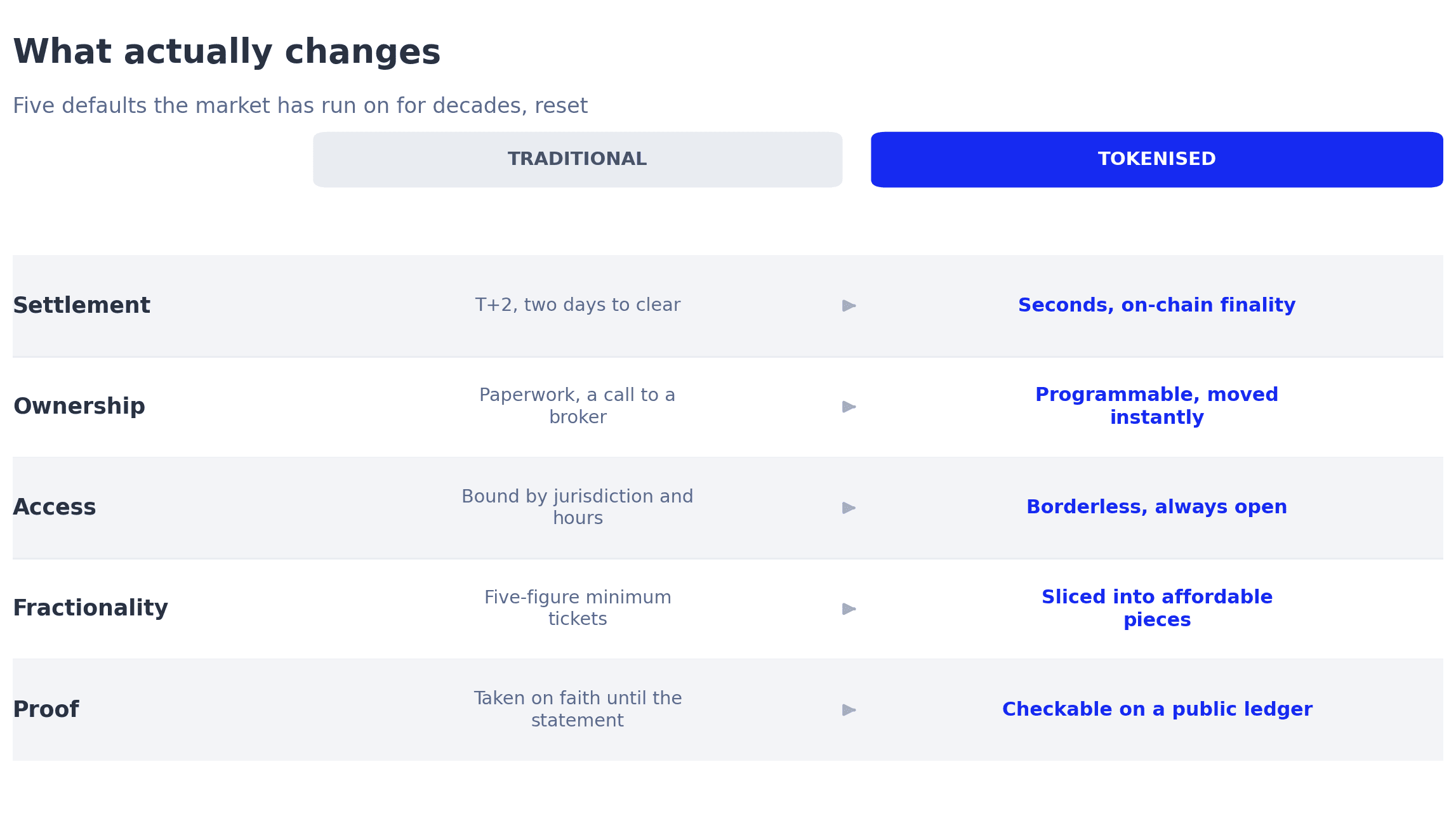
The shift is subtle enough to miss and large enough to reset the market’s defaults:
Settlement: what used to clear in two days now finalises in seconds. No more waiting on the other side to pay.
Ownership: stops needing paperwork or a broker’s sign-off. A holding can be split, pledged or moved the moment it is yours.
Access: jurisdiction and office hours stop being the constraint. A token trades at 2am on a Sunday just as easily as noon on a Tuesday.
Fractionality: the five-figure minimum disappears. What used to require serious capital can now be bought in tiny portions.
Proof: reserves and ownership live on a ledger anyone can check, not a statement you take on trust once a quarter.
This is not theoretical. The on-chain market for tokenised real-world assets, such as tokenised stocks, grew from around $6 billion in early 2025 to north of $31 billion by mid-2026. Capital does not move at that velocity for a novelty. It moves once the largest allocators have quietly decided the rails can be trusted.
Six networks, six separate bets
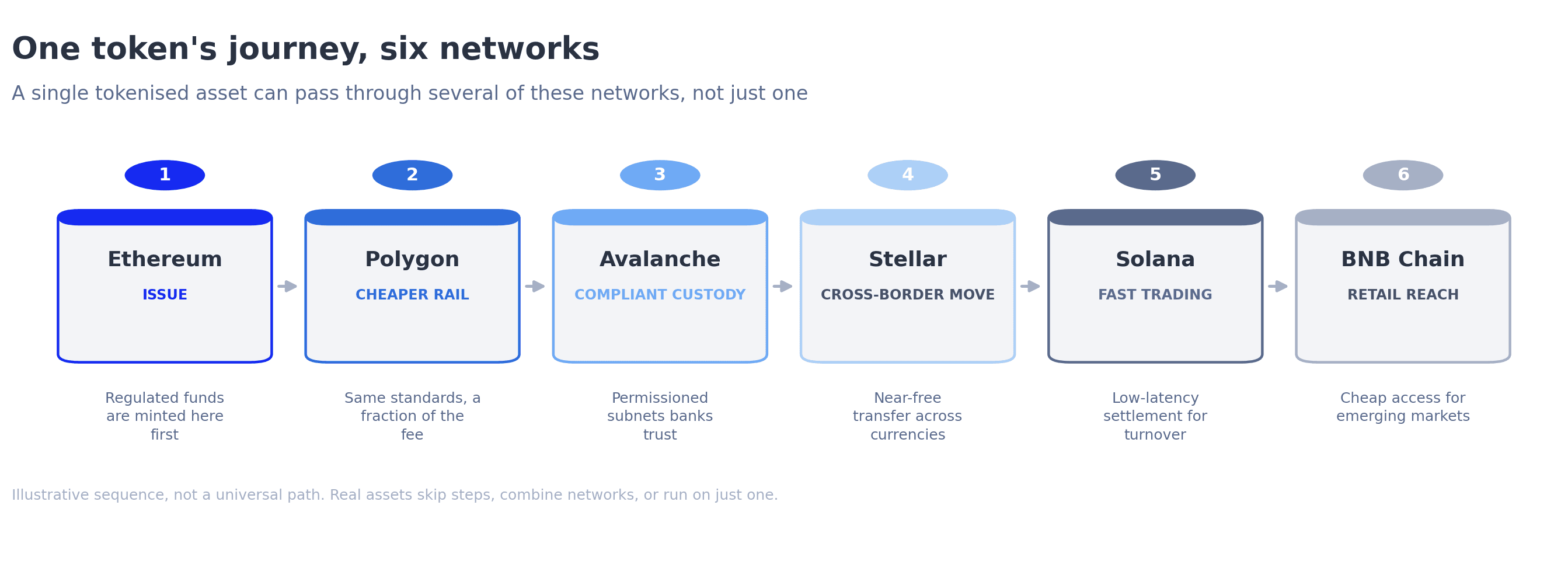
Tokenisation does not need a winner. Each of these networks has staked out a different reason to benefit as the market grows, and none of them depend on the others:
Ethereum holds the deepest pool of regulated issuance, which is why BlackRock and JPMorgan went there first. Institutional trust compounds, and Ethereum banked the earliest lead.
Solana‘s case is speed. As tokenised assets start trading rather than sitting still, low latency stops being a nice-to-have and becomes the requirement.
Stellar was built for compliant cross-border transfer before tokenisation was a headline, and it already carries the first SEC-registered fund to use a public chain as its system of record.
Polygon‘s case is arithmetic: Ethereum’s standards at a fraction of the fee, which is why Apollo and Franklin Templeton use it.
Avalanche is betting on compliance itself. Permissioned subnets are why banks like Citi pilot there rather than in the open market.
BNB Chain is the access bet. Cheap fees matter most where the fee is the barrier, retail and emerging markets, which is where it sits closest.
None of these theses need the others to fail. If tokenisation keeps growing, all six have a plausible route to relevance, on different parts of the same expanding market.
The part the data won’t settle
None of this tells you when it arrives, or that the version that lands looks like the pitch. The direction is set. The pace and the winners are not.
Tokenisation reshaping the market, and reshaping it soon, are two different claims. Only one has evidence. Where you sit in that gap is the real question, and nobody can answer it for you.
Quick takes
🔄 Ackman buys back the stock that cost him $400 million
Bill Ackman’s Pershing Square is buying Netflix again, four years after exiting at a $400 million loss. Since then, EBIT margins have climbed from 21% to 31.5%, and the stock trades at 21 times forward earnings versus 40 times before its 50% drawdown. Netflix headlines a broader six-stock overhaul that also added Visa, Mastercard, S&P Global and Intercontinental Exchange. Read more
🚀 Anthropic could out-price the biggest IPO of the year
Anthropic is reportedly aiming for a valuation of $2 trillion or more when it lists around October, a number that would top SpaceX’s already-rich $1.75 trillion debut in June. The case rests on revenue that surged to $11.5 billion in Q2, up from just $787 million a year earlier. But SpaceX’s own aftermarket is the cautionary tale sitting right next to the pitch: its valuation briefly topped $2 trillion before falling back, proof that a hot listing doesn’t guarantee a stable one. Without full financials yet public, investors are pricing potential, not proof. Read more
🔒 The float is shrinking faster than the supply
Public companies now hold over 1,075,000 BTC, nearly 5% of the total that will ever exist, with Strategy alone sitting on 660,000. Add an estimated 3-4 million BTC considered permanently lost, and the tradable float looks far smaller than the 20 million headline number suggests. Read more
Probably something
Tuesday close: $62.96
Wednesday close: $174.38
In one session, Moderna added more than its entire market value had been worth the day before, after it and Merck reported that a personalised mRNA cancer vaccine cut the risk of melanoma recurring or spreading in a late-stage trial. The same mRNA platform that built a COVID vaccine in under a year just delivered the first successful late-stage result for an mRNA cancer treatment, and the market re-priced the entire company overnight to reflect it.