IN THIS ISSUE (15) - 14 September 2026
👻 Who is Satoshi Nakamoto?
🍏 Apple enters the foldable world
🛢️ Oil is climbing sharply
💸 Lowered Fees on ZARU pairs
THE WEEK IN MARKETS
The week was a warm-up for a number that had not landed. August CPI prints Friday, the last inflation read before the Fed meets on 16 September, and everything leading in leaned hawkish: payrolls ran hot, with the US adding 162,000 jobs in August against the roughly 53,000 expected, and Warsh used Jackson Hole to signal the inflation job was not finished. The market now prices the hike as a coin toss.
Then oil made the case for a hike itself. Brent broke back above $100 for the first time since July, up almost 6% to around $101, after US strikes on Iranian tankers and Houthi attacks on Saudi facilities kept the Strait of Hormuz shut. Cheaper energy was the entire disinflation story a month ago. Equities barely moved at the index level, though Intel, AMD, Oracle and Micron all ran on the AI-infrastructure bid. Crypto dozed: Bitcoin held just below $79,000, roughly flat, while Polkadot led an alt pop of close to 30%.
🔥 WHAT'S UP: Brent crude | +5.8% | 1 week
💧 WHAT'S DOWN: Apple | -3.0% | 1 week
Data correct as at 10 September 2026.
THE BIG READ
The most disciplined trade in history is doing nothing
Somewhere across roughly 22,000 wallet addresses sits about 1.1 million Bitcoin that has not moved since 2010. At today's price that is around $86 billion, give or take a volatile afternoon, and it belongs to a person nobody has ever conclusively identified. The usual way to write about Satoshi Nakamoto is as a whodunit. The more interesting story is that the richest wallet in crypto has spent fifteen years doing the single hardest thing in this market: absolutely nothing.
The stash, by the numbers
Nobody has a wallet labelled "Satoshi." The estimate is forensic:
In 2013, research first published by Sergio Demián Lerner found a fingerprint in Bitcoin's earliest blocks, consistent nonce values marking one dominant miner. The cluster is now called the Patoshi pattern.
It links ~22,000 blocks from 2009-2010, each carrying the original 50 BTC reward.
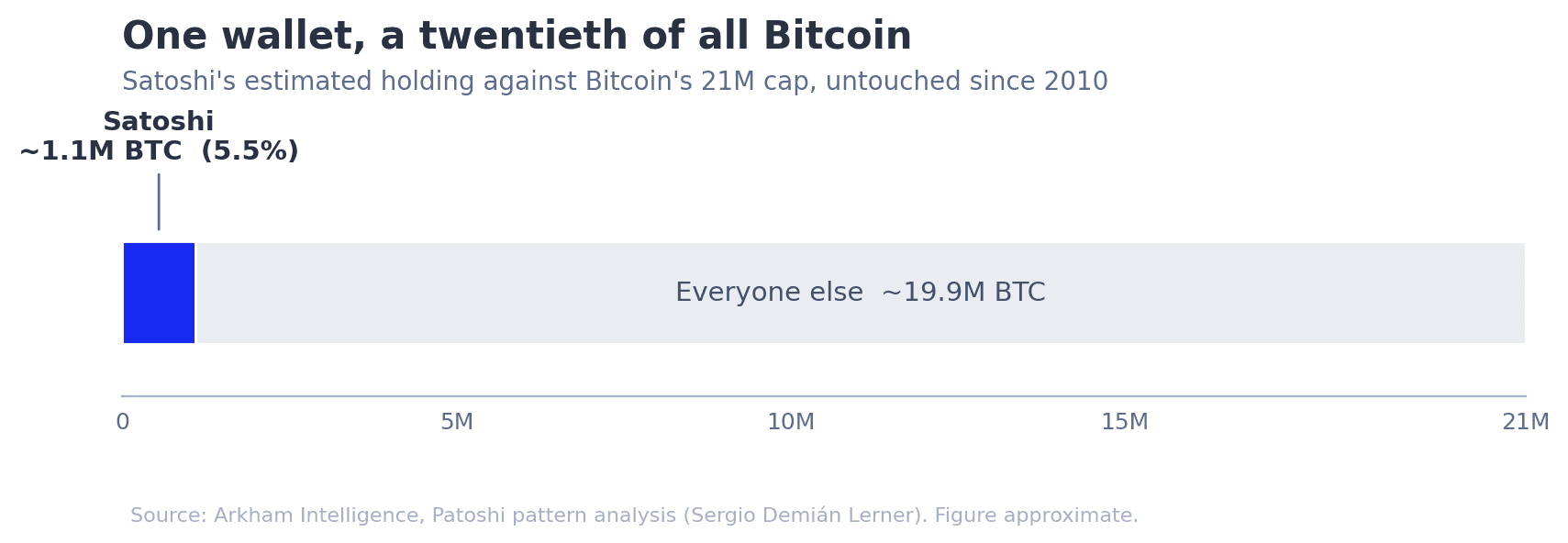
That totals 1 to 1.1 million BTC, roughly 5.5% of the 21 million that will ever exist.
About 99.9% has never been spent, while most other coins from that era have. That gap is what convinces researchers it is one entity who simply stopped.
Why cold storage is the whole point
Strip the mystique and Satoshi's wallet is the ultimate self-custody case study. No exchange, no custodian, no recovery flow. The keys exist or they don't. The other half of "hold the keys, hold the coins" showed up in this newsletter weeks ago, when a firmware flaw drained upwards of $100 million from Coldcard wallets whose owners did everything right. If you want the discipline without the single point of failure, it is worth understanding how Luno secures the crypto you hold.
The overhang nobody prices
A wallet that never trades still shapes the market, because the market has to price the day it might. The tail risk of those coins waking up is effectively zero and never quite reaches zero, which is exactly what lives in the back of a trader's model.
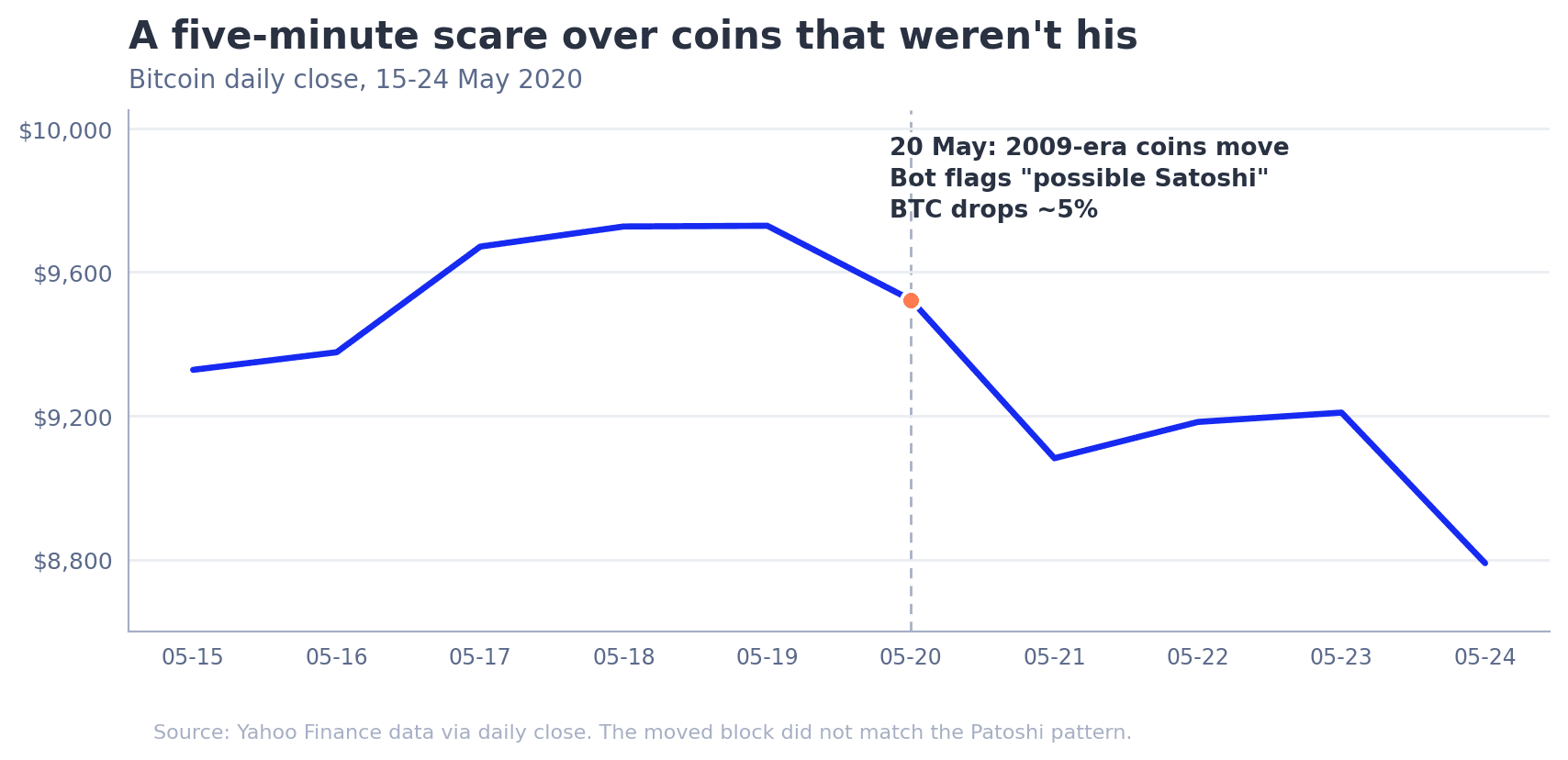
The reflex has been tested. On 20 May 2020, 50 bitcoin from February 2009 moved for the first time in eleven years. A bot flagged the wallet as "possibly Satoshi," and Bitcoin dropped around 5% within minutes. Lerner confirmed the block didn't fit the Patoshi pattern, so it almost certainly wasn't Satoshi's. Coins old enough to raise the question knocked billions off the market for an afternoon.
The discipline that only works untested
The stash stabilises the market precisely because it stays still: founder supply that never dilutes, a fortune that never becomes sell pressure. The moment it moves, it stops being that. Whether that is design, lost keys, or a promise kept by someone long gone is the one thing fifteen years of silence hasn't told us, and the one thing it doesn't need to.
The best-performing wallet in crypto history did nothing and never touched the keys.
QUICK TAKES
🏛 CLARITY meets its hardest vote yet
The Senate holds a cloture vote on the CLARITY Act on 15 September, the market-structure bill that would split crypto oversight between the SEC and CFTC. It needs 60 votes, Republicans hold 53, and three fights remain unresolved: ethics rules around the president's crypto holdings, DeFi developer liability, and stablecoin yield. Read more
🔤 Berkshire turns tech?
Berkshire Hathaway spent fourteen straight quarters selling stocks, then turned net buyer in Q2, and the pivot was a tech name. It lifted its Alphabet stake about 83% to roughly $37.8bn, now its third-largest holding, with $10bn of that funnelled straight into Alphabet's $80bn AI raise. The man who built an empire on not understanding tech just made Google's parent a top position. "I initiated it," Buffett said, in case anyone blamed his successor. Read more
🪙 South Korea puts a date on tokenisation
South Korea's financial regulator has set 4 February 2027 as the day tokenised stocks, bonds and funds gain legal recognition, the start of a three-phase plan to move traditional securities onto public-ledger rails. Phase one is institutional and cautious; the stablecoin-settlement ambitions come later, if phase one holds. The tell is the audience: a market with 11.3 million verified crypto users and retail stock volumes that rival its exchanges. The demo phase keeps ending in more places. Read more
PROBABLY SOMETHING
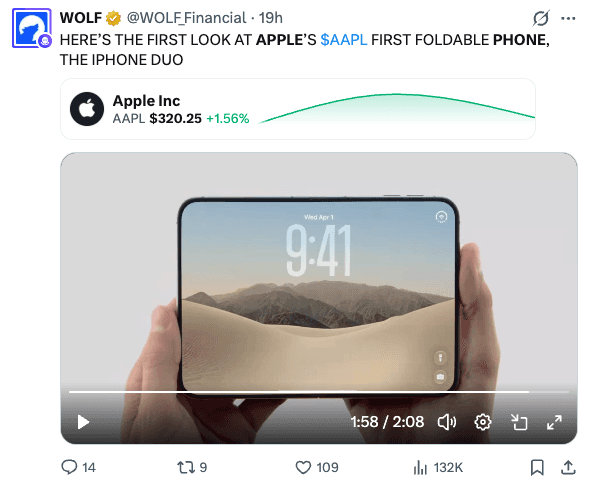
Apple unveiled the iPhone Duo, its first foldable smartphone, starting at $1,999 and opening to a 7.6-inch screen. It’s framed as a move into a brand-new category, which is a generous way to describe a shelf that competitors have owned since 2019. It is the biggest change to the iPhone's shape since 2007, and the market thanked Apple by selling it down 3% on the week and buying chipmakers instead. The pioneer shows up last, and at full price. Watch here