Probably nothing
Separating the signal from the noise
IN THIS ISSUE (14) - 31 August 2026
🤑 Gold walks, Bitcoin sprints
📱 Meta agrees to pay a $16.7b fine
⚡ HYPE hits a record while Bitcoin stalls
The week in markets
Hyperliquid’s HYPE printed an all-time high near $83, up about 11% and now inside the top ten, a perpetuals-exchange token leading a market whose flagship still cannot clear its own ceiling. The rotation ran wide, Solana up roughly 16%, XRP 11%, Ether 7%. Bitcoin managed 8% to just under $79,000 and brushed a monthly high, then stalled at the wall it has failed to break all year.
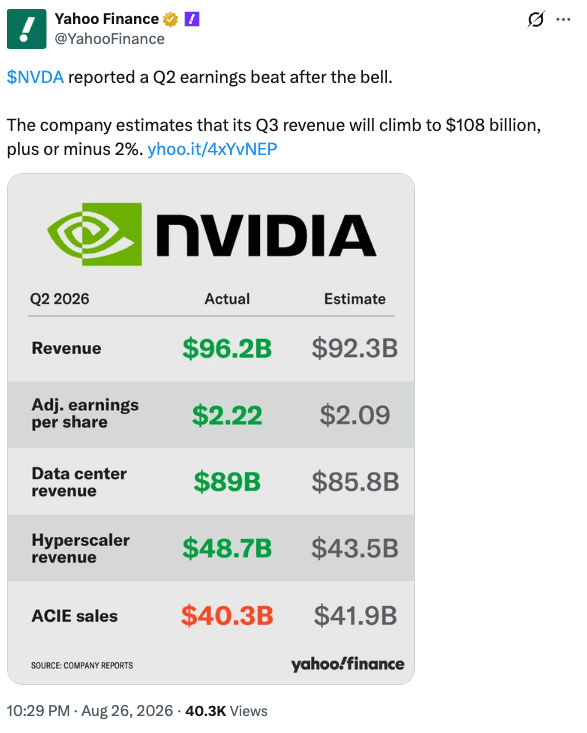
Two events bracketed the week. Nvidia reported another blowout on Wednesday, revenue up 106% to a record $96 billion and guidance of $108 billion, and the broad tape still finished soft, with the number everyone cares about landing Friday. Fed Chair Kevin Warsh gives his first Jackson Hole keynote with September hike odds down to under four in ten and core inflation stuck at 3.3%. Gold read it the obvious way, hitting a 15-week high near $4,700 before easing. Oil went the other way, Brent shedding almost 9% to about $86 as the Iran risk premium deflated. Crypto sat out all of it.
🔥 WHAT’S UP: Hyperliquid (HYPE) | +11% | all-time high
💧 WHAT’S DOWN: Brent crude | -8.5% | 1 week
Data correct as at 26 August 2026.
The big read
Gold and Bitcoin are the same trade
For years the two got sold as rivals. Gold was the serious hedge your uncle trusted, Bitcoin was the one that would either replace the financial system or hit zero by lunchtime. Strip away the marketing and they prove to be the answer to the same question, one that keeps getting louder.
The job they actually do
Neither asset is really a bet on itself. Both are bets against the currency they are priced in.
Spending outruns income: A government takes in less than it spends, so the shortfall gets funded rather than fixed.
Borrowing gets managed cheap: It leans on its own bond market to keep yields down, and the value of the money becomes the release valve.
Scarcity gets the bid: Anything that cannot be printed catches a bid, because it is the one thing the printing cannot dilute.
Gold has run this trade for a couple of centuries. Bitcoin is the same trade with a shorter history and a worse temper.
Here’s the picture
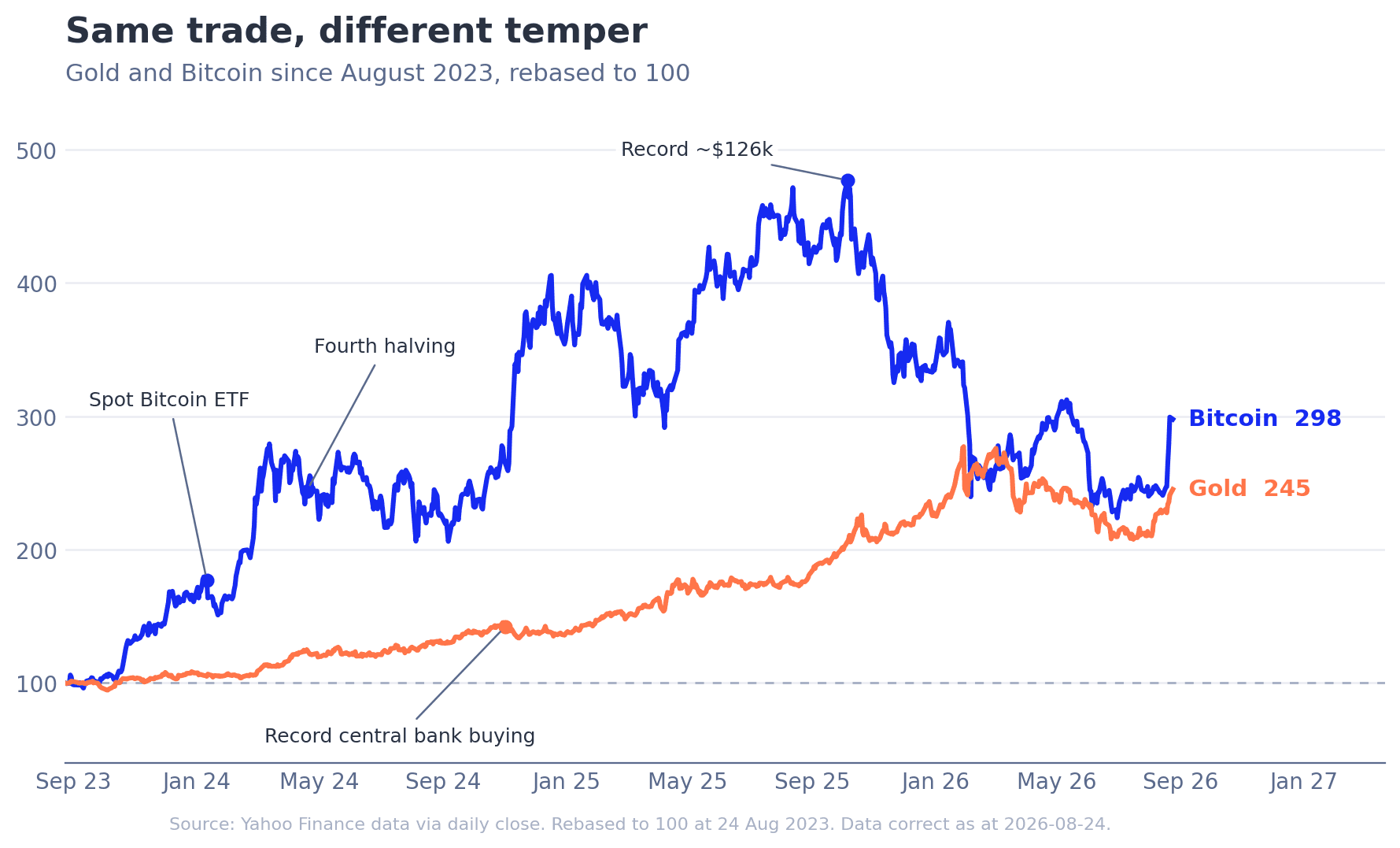
The two lines look like different bets. They are one bet at two risk settings. Across three years a single tide carried both: the Fed stopped hiking in late 2023, and the cuts that followed made assets without a yield cheap to hold again.
What set the amplitude apart was who showed up to buy. Gold had central banks buying more than a thousand tonnes a year for three straight years, a patient floor that lifted it to two and a half times its start in a near straight line. Bitcoin had a spot ETF and a supply halving three months later, a smaller and far more excitable buyer base arriving at once, which is why it nearly quintupled by late 2025, gave most of it back, and still sits near three times where it began. Same direction, five times the temper.
The slow reason and the fast one
Separate the two clocks these assets run on. The fast clock is news. Bitcoin’s recent jump came off Washington, a White House crypto summit and the SEC’s proposed Regulation Crypto Assets framework giving traders a reason to buy, a short squeeze doing the rest. Gold did nothing, because none of it was pointed at gold. That is a fast-clock move: loud, asset-specific, gone by the next cycle.
The slow clock is fiscal, and it ticks for both. Deutsche Bank called it soft-form financial repression: US debt has topped $40 trillion, and the Treasury recently doubled its long-bond buybacks after the 30-year yield hit a near two-decade high, leaning on its own market to keep borrowing cheap. That moves no price in any given week. It is why the chart points where it does, and why a regulatory headline can fade without the case for either asset fading with it.
Both sit one tap apart on Luno.
Quick takes
🪙 Tokenisation gets a sovereign test case
Japan is reportedly drawing up rails to settle stocks and government bonds on a blockchain around the clock, cutting today’s one to two day wait toward zero. The prize is a government bond market worth roughly $7 trillion, the clearest sign yet of what happens when tokenisation leaves the demo phase and arrives at sovereign scale. The catch is the timeline: a study group this summer, a plan by 2027, live in the early 2030s. The pitch is finally real, it just runs on a government schedule. Read more
📱 Meta agrees to pay a $16.7 billion fine
The settlement cut short a federal trial in Oakland, landing days before Zuckerberg was due to take the stand. To end it, Meta agreed to switch off a list of its own growth features for under-18s: a two-hour daily cap, an overnight blackout, muted school-hour notifications, hidden like counts, and an opt-out of the algorithmic feed. The strictest limits only bite if TikTok and YouTube sign up too. Nobody wants to be the only app dialing down engagement. Read more
🤝 Big cloud wants a cut of Kimi
Moonshot is reportedly in talks with Microsoft, Amazon and Google to host its Kimi K3 model, with the Beijing lab seeking up to 30 percent of the revenue it generates on their platforms. It would be the first revenue-share of its size between a Chinese model maker and a major cloud provider. The tell is that the hyperscalers get paid hosting a model they did not train. Being the landlord still beats being the builder. Read more
Probably something
Nvidia posted a $96.2 billion quarter, up 106% year over year, and guided to $108 billion for the next one, a figure only a handful of companies have ever printed even once. Data centre revenue alone hit $89 billion, up 117%, at 75% margins, while Jensen Huang declared AI “past its inflection point” and said compute is now revenue. The quieter fact is that Nvidia is increasingly bankrolling the buildout it profits from, taking stakes in the labs and neoclouds that buy its chips, which makes record demand and vendor financing harder to tell apart. Read more