
Last month in a nutshell
August turned on a single room in Washington. At a White House meeting with crypto and finance leaders, President Trump pressed the Senate on the CLARITY Act and said the CFTC was working to bring Hyperliquid onshore legally (Crowdfund Insider). That signal, plus a weaker dollar and the Treasury’s move to double its long-dated bond buybacks from September, ended crypto’s summer malaise. Bitcoin broke $80,000 for the first time since mid-May, touching $81,257 on 25 August, its strongest week in about three years. Still well below October’s $126,000 peak, so a recovery rather than a new high, but the lifting came from ETF inflows and a short squeeze, not retail (Bloomberg).
The rally broadened fast. Hyperliquid’s HYPE token printed a fresh all-time high above $83 on that same CFTC signal (The Crypto Times). The counterweight sits in the Gulf: June’s Hormuz memorandum lapsed on 17 August with no deal, Trump threatening Oman as Strait traffic stalled and oil firmed (Bloomberg). August handed institutions the upside and the tail risk at once.
Data correct as at 27 August 2026.
Key themes
The most expensive trade you never watch: Scheduled rebalances telegraph one-directional flow into thin books, and the cost hides inside your own benchmark.
The breakout retail sat out: Bitcoin cleared $80,000 for the first time since May, lifted by ETF inflows and a short squeeze rather than a retail bid.
Hormuz runs out the clock: June’s Strait memorandum lapsed with no deal, firming oil and handing institutions August’s tail risk alongside its upside.
The big idea
The rebalance is where the alpha leaks
Institutions pour enormous effort into entry and exit, yet the rebalance that sits between them gets waved through as routine housekeeping. It is quietly the most expensive trade most desks never think to watch.
Why the rebalance is predictable
Every mandate with a crypto sleeve rebalances on a schedule:
Month-end or quarter-end resets
Fixed drift-band triggers
Policy-weight restoration after a large move
That discipline is sound portfolio construction. It is also completely legible to the market. In a venue with a consolidated tape and deep books, predictability costs little. In crypto, where liquidity is thin and fragmented, a telegraphed, one-directional flow arriving in a known window is an invitation. Liquidity providers don’t need to see your order to position for it. They need only a calendar.
How the leak compounds
When telegraphed, one-directional demand lands on a book already shallower than the screen suggests, the price impact is not trivial and it is not a one-off. It recurs every cycle, and it compounds.
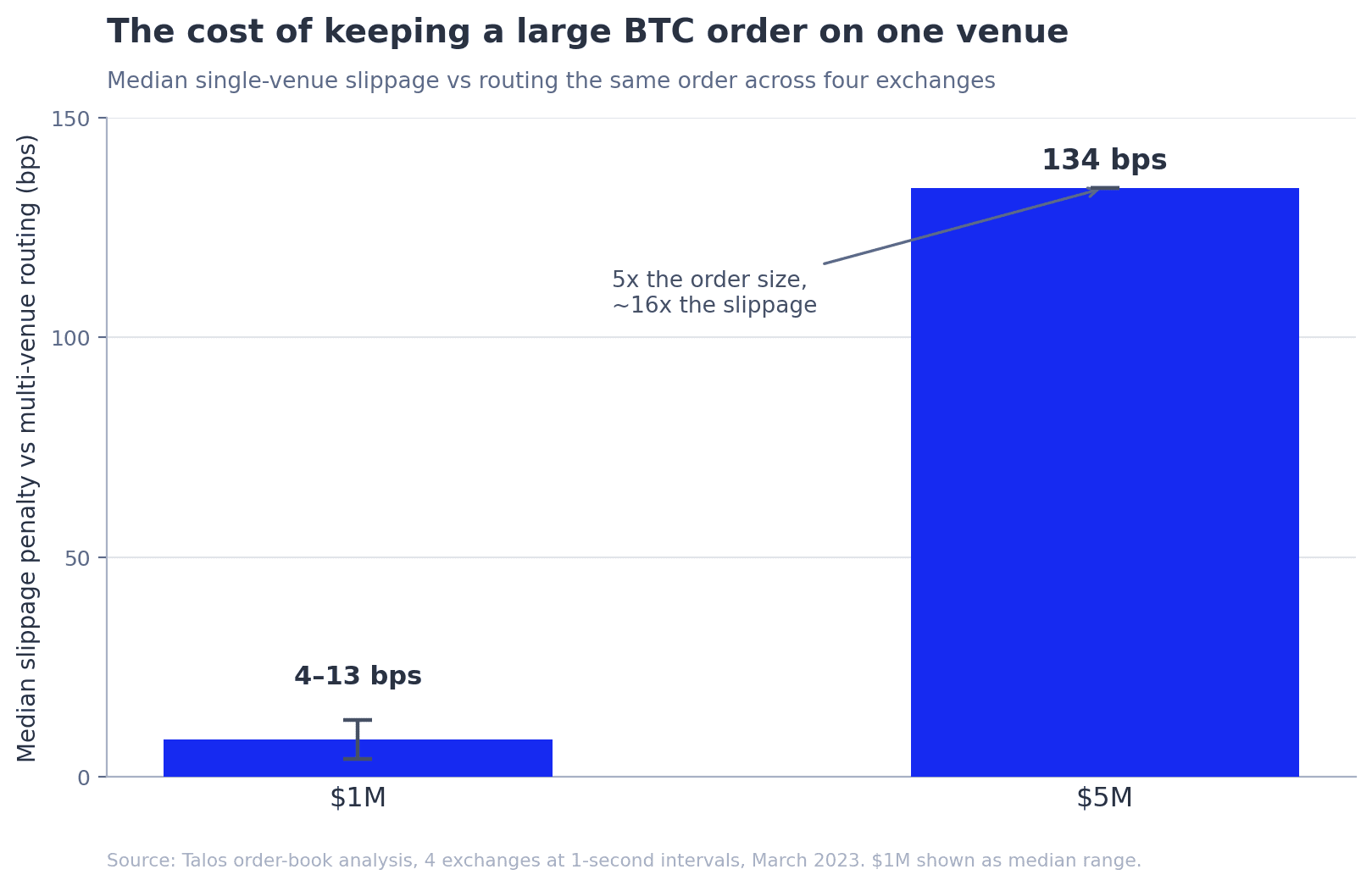
The scale is measurable. In a Talos analysis of multi-venue liquidity, the execution firm read the order books of four exchanges at one-second intervals and priced institutional-sized BTC orders. A $1 million order sent to a single venue cost 4 to 13 bps more than the same order spread across all four. At $5 million, the single-venue penalty reached 134 bps. Five times the size, roughly sixteen times the cost. That is the curve every predictable rebalance climbs, and it is the gap against multi-venue routing, which still leaves the order sitting on lit books.
Why your TCA doesn’t catch it
Transaction cost analysis benchmarks each fill against a mid that the flow itself moved. The cost of being predictable gets absorbed into the benchmark rather than measured against it. The desk sees “in line with market” and moves on. The alpha has already left the building.
On-screen vs. off-screen: the same rebalance, two outcomes
Public order book | Bilateral OTC block | |
Market signal | Visible schedule, one direction | None |
Front-running risk | Child orders reverse-engineered | No footprint to read |
Price at fill | Moved by your own flow | Negotiated, agreed rate |
Settlement | Fragmented across venues | Single counterparty |
Measured cost | “In line,” true cost hidden | Priced up front |
The bridge
Bilateral OTC execution breaks the pattern. A rebalance moved off-screen as a negotiated block sends no calendar signal to the market. No visible schedule to front-run, no child orders to reverse-engineer, no price print repositioning liquidity providers before the trade completes. Settlement happens at an agreed rate, and the flow that used to announce itself simply doesn’t. For any mandate rebalancing at institutional size, that is the difference between a cost you can’t see and one you don’t pay.
Luno’s OTC Desk is built for exactly this: off-screen execution at size across South Africa, Nigeria, and Kenya, with a simplified sign-up for verified business customers and a dedicated in-app experience for high-volume trading.
The rand-backed stablecoin, on-chain and in motion
ZARU is accelerating. The leading rand-backed stablecoin built for institutional use, issued by Luno’s sister company BlockTower.
Two figures from MoneyBadger’s 2026 report show where rand-backed stablecoins are heading:
By July 2026, ZARU accounted for 98% of rand-stablecoin payment value on South Africa’s leading crypto payments network.
ZARU payments grew 61% from June to July alone.
Six months after launch, the rand isn’t just going on-chain. It’s being spent. Everyday purchases, settled in seconds, around the clock.
One ZARU, more places to put it to work
A stablecoin is only as useful as the rails it runs on and the places it’s accepted. ZARU, the leading rand-backed stablecoin built for institutional use, issued by Luno’s sister company BlockTower, expanded on both fronts this quarter.
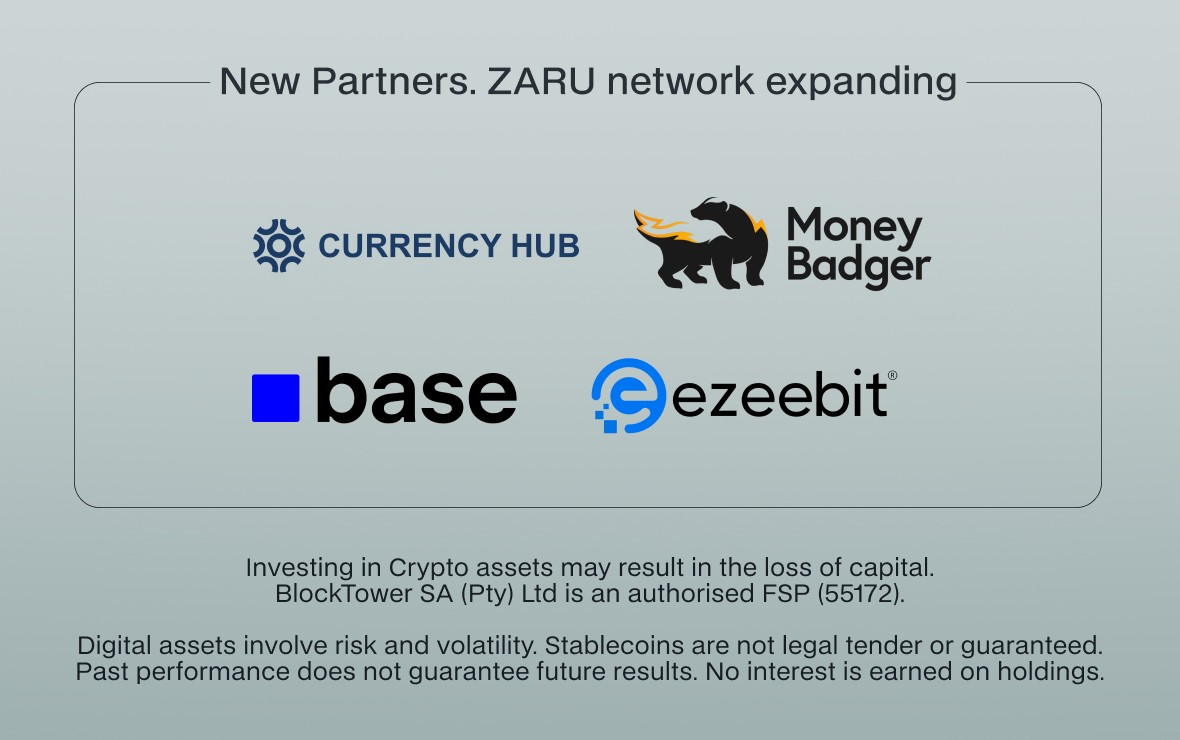
Live on Base: Coinbase’s Ethereum layer-2, opening a path to the global on-chain liquidity and DeFi infrastructure that a rand-denominated asset has historically been walled off from.
Currency Hub as dedicated market maker: The piece that most directly serves institutional flow. A committed market maker means deeper liquidity and tighter spreads, turning a rand-backed stablecoin from a settlement token into something a desk can move size in.
Accepted across MoneyBadger’s network: 650,000+ merchants, with ezeebit adding further platform and merchant reach.
Taken together: more platforms, more merchants, one ZARU. The instrument that clears an institutional mandate is the one that also settles, trades, and spends in the real economy.
Register your interest in using ZARU today.
Investing in Crypto assets may result in the loss of capital. BlockTower SA (Pty) Ltd is an authorised FSP (55172).
Digital assets involve risk and volatility. Stablecoins are not legal tender or guaranteed. Past performance does not guarantee future results. No interest is earned on holdings.
Quick takes
1️⃣ The SEC finally writes a rule
The SEC has proposed “Regulation Crypto Assets,” its first purpose-built framework for token offerings and a clean break from the enforcement-led era. Two exemption tracks anchor it: a startup raise up to $5 million over four years, and a disclosure-heavier path up to $75 million a year, plus a safe harbour and pre-emption of state registration. Chair Paul Atkins stressed that rulemaking is no substitute for legislation, a nod to the stalled CLARITY Act. For institutions, a usable US perimeter is forming even as Congress stalls. Comment window: 60 days. SEC
2️⃣ Nvidia clears the bar again
Nvidia posted record fiscal Q2 revenue of $96 billion, more than double a year ago, with adjusted EPS of $2.22 against a $2.09 consensus and data centre revenue up 18% quarter-on-quarter to $89 billion. Guidance ran ahead of the street, and management flagged a supply-constrained outlook, guiding to roughly 70% revenue growth in fiscal 2028. A fresh AWS deal for two million GPUs plus the new Vera CPU underlined that hyperscaler spend is not tapping out. CFO Colette Kress put top-five hyperscaler capex at $1.3 trillion next year, up from $800 billion in 2026. CNBC
3️⃣ Strategy dials leverage to near zero
Strategy, the largest listed Bitcoin holder, has cut its net leverage to almost nothing, raising $2 billion in equity to build $6.69 billion in dollar liquidity against roughly $6.75 billion of debt, without selling any coins. After dropping its “never sell” stance in May, it now runs as a deleveraged treasury vault rather than a leverage engine, which de-risks the balance sheet but compresses the premium the equity once commanded, leaving MSTR trailing the spot Bitcoin ETF it was built to beat. CoinDesk
The bigger picture

The price is the wrong number to watch
When Bitcoin sells off and recovers, the price swing is the headline, and the lagging indicator. The durable signal for institutional desks is where regulated capital is moving, read most clearly through US spot Bitcoin ETF flows. Earlier in 2026 those products shed more than $8bn over roughly two months, per SoSoValue data cited by Investing.com. Then flows reversed, with CoinDesk reporting the strongest weekly inflow in months, led by BlackRock’s IBIT.
Read the flows, not the candle. Price and inflows moving together points to institutional money re-entering, not a positioning squeeze, though a few strong weeks don’t erase the year’s earlier outflows. For mandates rebuilding exposure, execution quality on size separates catching the trend from moving the market against yourself.